
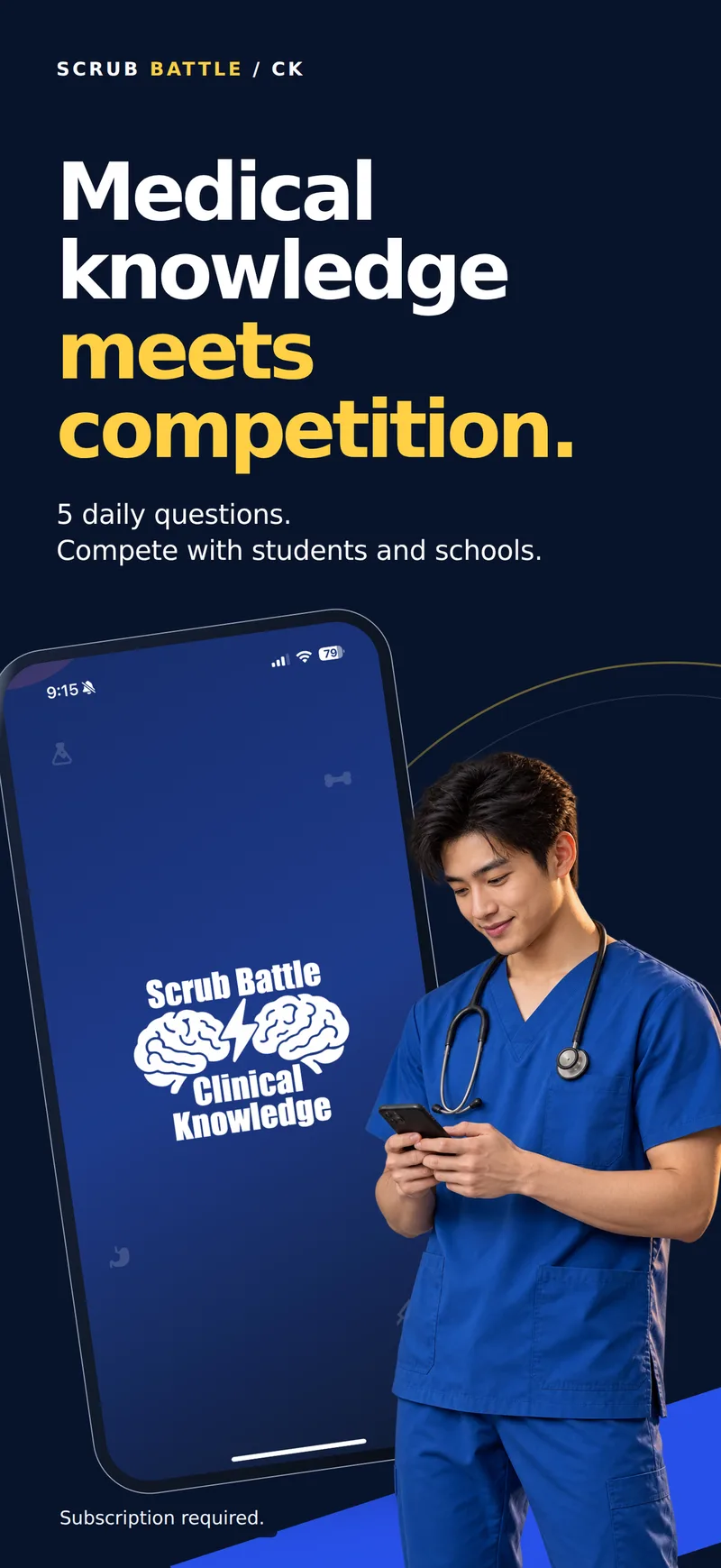
Five clinical questions. Every day. See where you rank.
Answer five clinical questions each day, review the explanations, and compare your performance with other medical students.
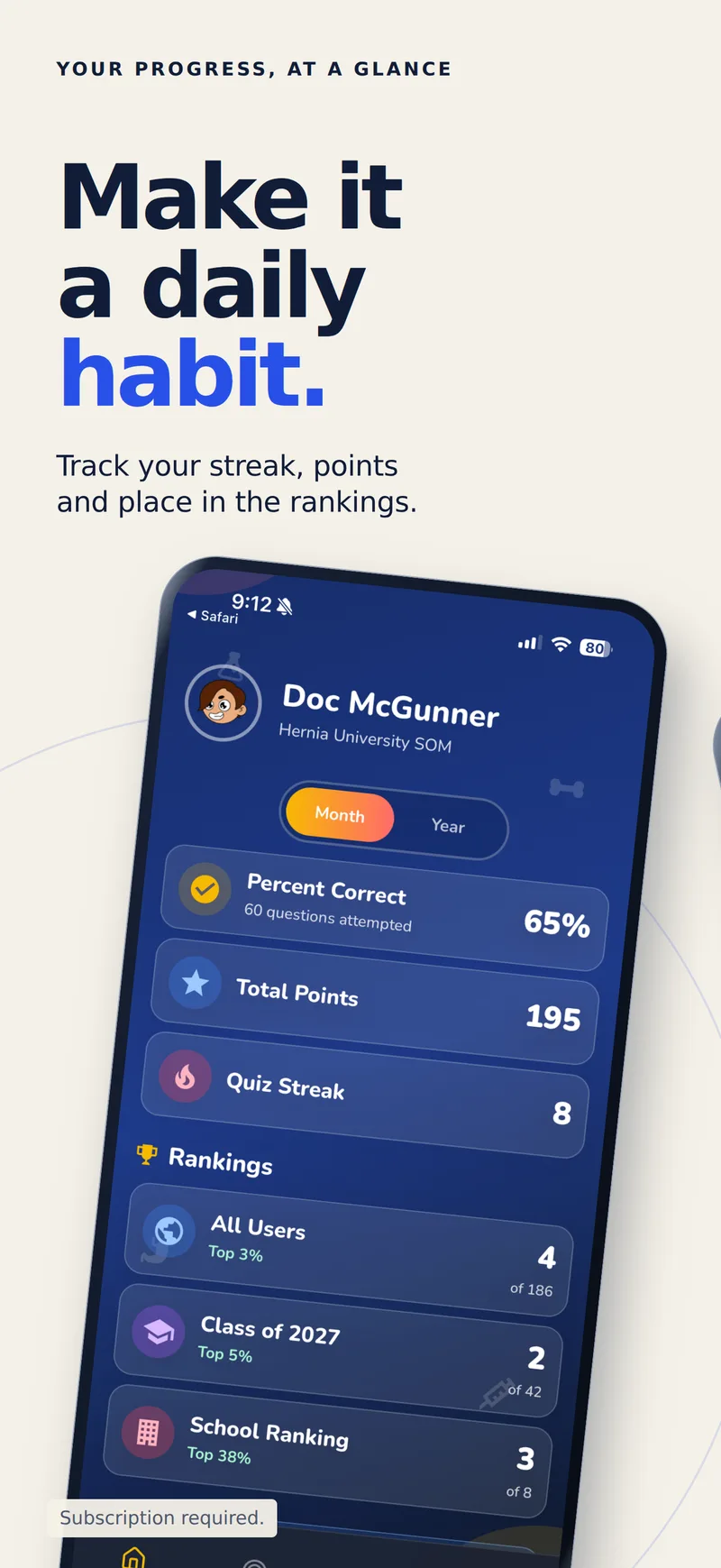
Make it a daily habit.
Keep your performance, points, quiz streak, and rankings together in one place.
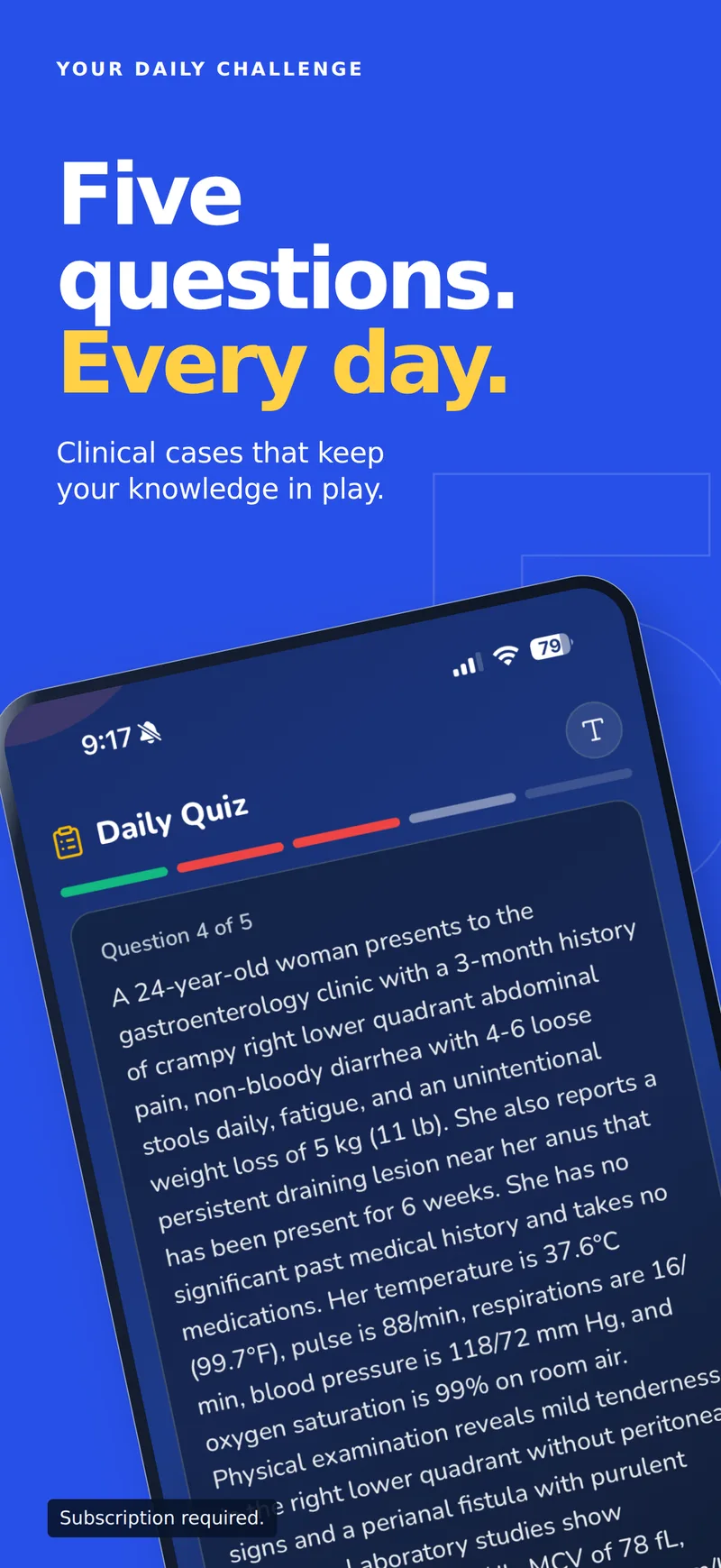
A new clinical challenge each day.
Work through today's cases, commit to your answers, and build your score.
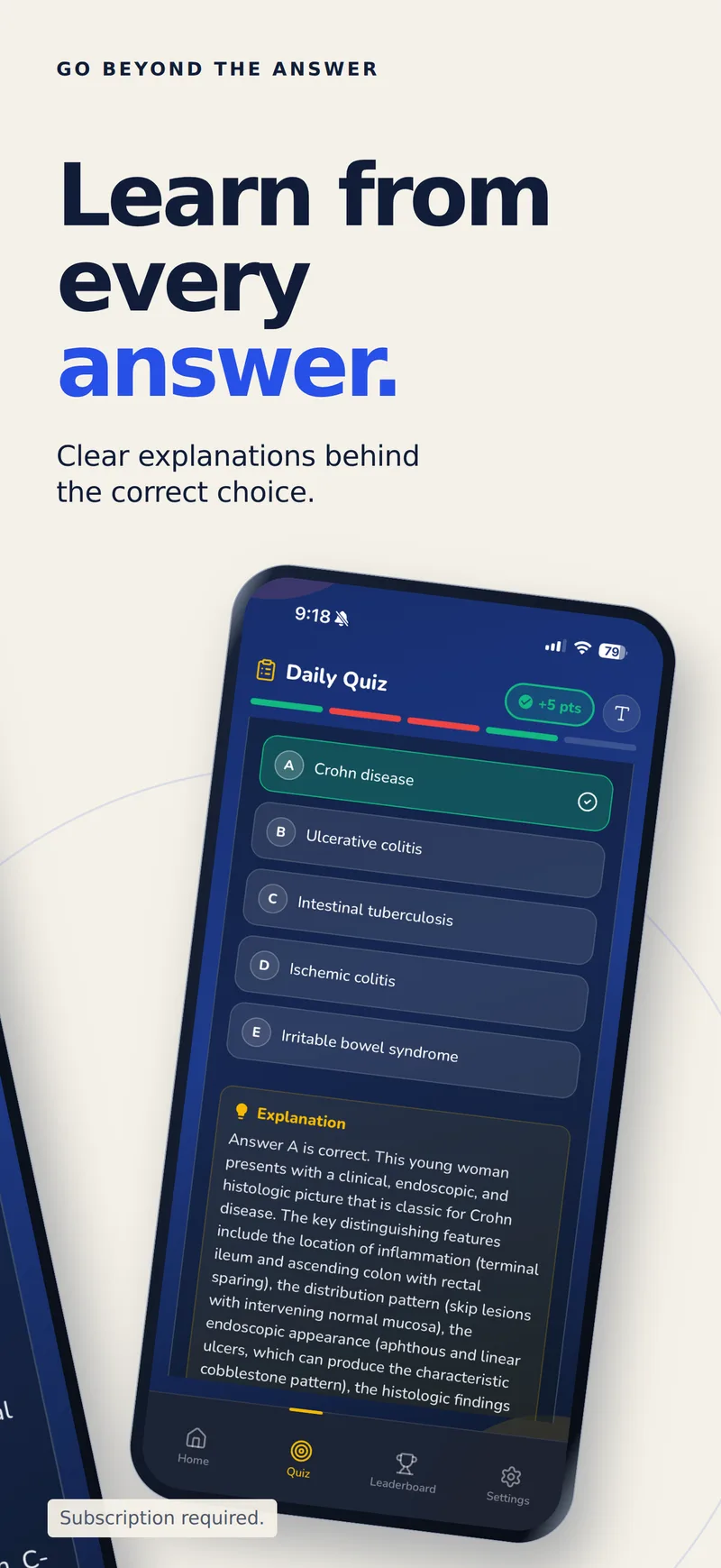
Learn from every answer.
After each question, review the correct choice and the reasoning behind it while the case is still fresh.
See how you stack up.
Compare your score with other players or view the competition within your class year.
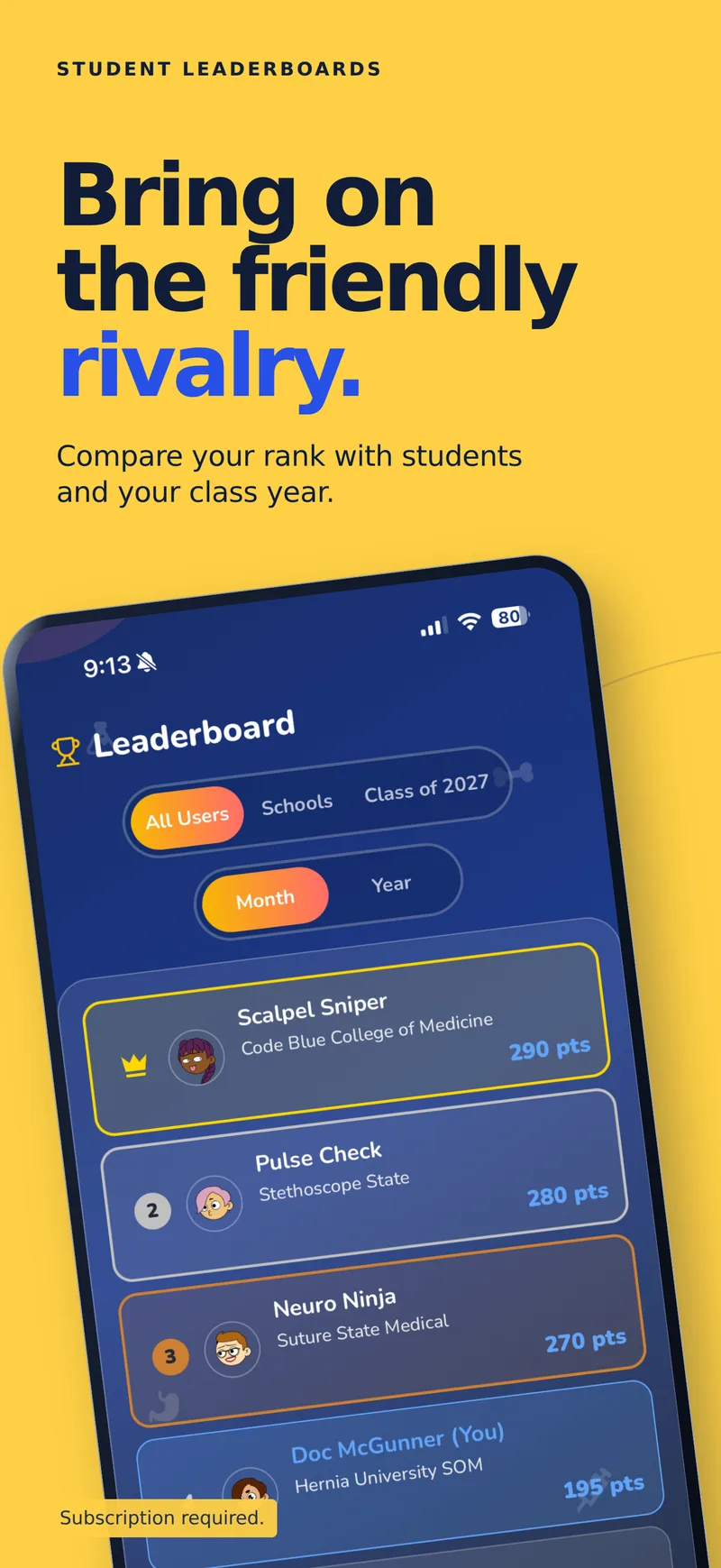
Students compete. Schools do too.
Check the school leaderboard to see how your medical school compares with others.
How the leaderboards work
How it works.
Scrub Battle: CK is a daily clinical knowledge quiz app for medical students. Students answer five clinical questions each day, review explanations, earn points, and compare their performance on student, class-year, and school leaderboards.
- 01
Answer today's five questions
- 02
Review each explanation
- 03
Earn points for correct answers
- 04
Check your student, class-year, and school rankings
Built by people who teach medicine.
Scrub Battle was created by clinicians and medical educators who wanted to make clinical question practice more engaging, more social, and easier to return to every day.
Useful clinical questions. Clear explanations. A little competition along the way.
Meet the team behind Scrub BattleKeep learning off the app.
Explore short-form medical education from the Scrub Battle team.
Surgery Shelf Prep
Intra-Abdominal Abscess
Intra-abdominal abscesses can be easy to miss—especially when the skin incision looks completely normal. On the Surgery Shelf, the key is recognizing the postoperative pattern, knowing when to image, and understanding when drainage or surgery is the next best step. In this episode, Chris and Mars break down the classic presentation of intra-abdominal abscess, the role of CT imaging, and the core treatment principle of antibiotics plus source control. You’ll learn when percutaneous drainage is preferred, when operative management is necessary, and how hemodynamic instability changes the entire plan. We also review one of the most practical postoperative concepts: what your drain output is telling you. Clear fluid? Check creatinine for urine. Milky output? Check triglycerides for chyle. Pancreatic concern? Check amylase. Bilious drainage? Check bilirubin. Feculent output? Think bowel leak or fistula. Plus, we cover persistent fever after drainage, clogged or malpositioned drains, loculated collections, and key surgery shelf-exam traps that can change management.
Listen to the episodeMedicine Shelf Prep
Hypertrophic Cardiomyopathy
Hypertrophic cardiomyopathy is an inherited myocardial disease characterized by unexplained left ventricular hypertrophy, impaired diastolic filling, and sometimes dynamic left ventricular outflow tract obstruction. In this episode, Chris and Mars review the classic genetics and asymmetric septal hypertrophy of HCM, systolic anterior motion of the mitral valve, why the murmur gets louder with standing and Valsalva, exertional dyspnea, angina, syncope, and sudden cardiac death, echocardiography and cardiac MRI findings, beta blockers as first-line treatment for symptomatic obstructive HCM, medications and volume changes that can worsen outflow obstruction, sudden-death risk assessment and implantable cardioverter-defibrillator indications, and atrial fibrillation, anticoagulation, exercise, genetics, and family screening. Episode pearl: In obstructive HCM, a smaller left ventricular cavity means more obstruction—which explains both the murmur maneuvers and many of the treatment decisions.
Listen to the episodeSurgery Shelf Prep
Surgical Site Infection
Surgical site infections are a Surgery Shelf favorite because one postoperative wound can test timing, diagnosis, source control, prevention, and even the need for emergency surgery. In this episode, Chris and Mars break down how to recognize superficial, deep, and organ-space infections—and how management changes with each one. You’ll review the classic postoperative timing of wound infections, dangerous early clues for necrotizing infection, when to open and drain a wound, when systemic antibiotics are needed, and when an intra-abdominal collection requires percutaneous or operative source control. We also cover the prevention details worth knowing for the shelf: perioperative temperature goals, glucose control, chlorhexidine-alcohol versus povidone-iodine skin preparation, clipping instead of shaving, appropriate prophylactic antibiotics, and the four surgical wound classes—clean, clean-contaminated, contaminated, and dirty-infected.
Listen to the episodeQuestions, answered.
What is Scrub Battle: CK?
Scrub Battle: CK is a daily clinical knowledge quiz app for medical students. Students answer five clinical questions each day, review explanations, earn points, and compare their performance on student, class-year, and school leaderboards.
How many questions are available each day?
Five clinical questions are available each day.
How do points work?
Each correct answer earns 5 points, so you can earn up to 25 points a day. Your points determine your place on the leaderboards.
How do the leaderboards work?
Players are ranked by the points they earn from the daily questions. You can see where you stand among all players, within your class year, and through your medical school on the school leaderboard.
Can I compare my score by class year?
Yes. The student leaderboard can be viewed by class year, so you can compare your score with students at the same stage of training.
How does the school leaderboard work?
Points earned by students count toward their medical school, and schools are ranked against each other on the school leaderboard.
Is a subscription required?
Scrub Battle: CK is free to download. Full access requires an active subscription.
Is there a free trial?
Full access requires an active subscription. Eligible new subscribers may receive a 3-day free trial.
Where can I download Scrub Battle?
Scrub Battle: CK is available for iPhone on the Apple App Store.